What is DaaS, and how does it differ from traditional development management services?

Written by
Rawan Haddad
Updated: Feb 04, 2026, 11:53 AM

Rawan Haddad
Real estate development has long depended on development management services, a model built around advisory and oversight, where developers coordinate a network of external consultants, project managers, designers, and sales teams.
Enter Development as a Service (DaaS): a modern, integrated model that expands on the development management model. From land acquisition to handover, DaaS is designed to offer developers and investors turnkey, hands-off solutions — while ensuring speed, quality, and control.
As part of our continuing series for Dubai real estate developers, this blog illustrates what development as a service is, how it differs from traditional development management, and who should consider its use.
DaaS is an end-to-end property development model that bundles together all the services required to take a real estate development project from concept to completion — and delivers them through a single, unified ecosystem.
Think of DaaS as a “plug-and-play” solution. Rather than sourcing individual consultants or service providers, developers or real estate investors can opt into a fully mobilized, in-house real estate infrastructure that can handle each vertical on their behalf.
Unlike traditional development management services which focus mostly on advisory and coordination, DaaS spans both advisory and execution across multiple verticals. These include:
The DaaS model also incorporates modular flexibility, allowing developers to select only the services they need — whether it’s just sales and marketing, or the entire development lifecycle.
DaaS is particularly valuable for:
With DaaS, these stakeholders don’t have to piece together a team. Instead, they tap into a fully built ecosystem that can be activated very quickly.
The Difference Between DaaS and Traditional Development Management: A Snapshot
While development management is crucial for advisory, coordination, and project oversight, DaaS expands the scope:
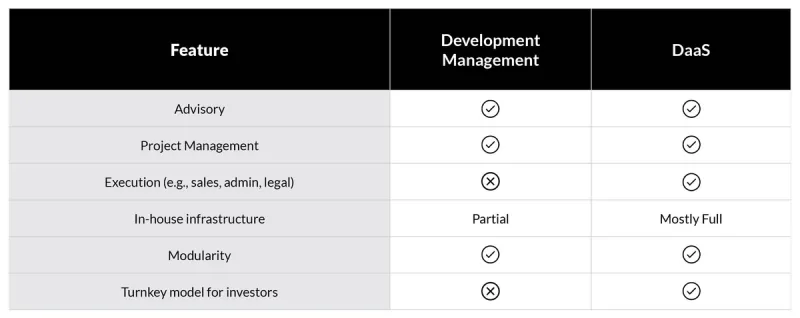
In short, if you’re only looking for pure advisory, choose development management; and if you’re looking for advisory and delivery, choose DaaS.
As the real estate industry continues to evolve, DaaS represents a shift toward consolidated, shareholder-friendly development. It provides a more structured, scalable, and efficient approach — one that aligns with the needs of developers, global investors, institutional players, and landowners looking to develop without building internal teams.
By combining strategic advisory with operational execution under one integrated model, DaaS is fast becoming the preferred approach for those seeking agility without the hassle of managing fragmented teams.
Development as a Service isn’t just a service model — it’s a new mindset for real estate delivery.

Learn about how Driven helps developers launch major projects
Get in Touch Now